
I’m sure you have noticed - the way users find information on Google is evolving rapidly. We are hearing a lot about GEO vs SEO daily.
GEO: Generative Engine Optimisation - Optimising for AI-led search
SEO: Search Engine Optimisation - Optimising for traditional search
With the rise of the Google AI Overviews (the AI generated summaries at the top of search results), appearing in these prominent positions is more valuable than ever for brands and businesses. It's not just about traditional SEO anymore; it's about optimising for understanding, conciseness and most importantly trust, by artificial intelligence.

So, how do you create content that Google's AI overview loves to feature?
It comes down to a deliberate ‘GEO’. An AI Overview Content Strategy focused on clarity, authority, and user intent. Here's your guide:
Answer questions directly and upfront
Google's AI is designed to provide immediate answers. Your content should mirror this intent.
Front load your answers: Immediately after your main heading or a prominent subheading, provide a clear, concise, 1-2 sentence answer to the question your content is addressing. Think of it as your AI-ready summary.
Target specific questions: Focus each piece of content around answering a primary question. Use question-based headings ("What is GEO?" or "How do I feature in google AI overviews?").
Example: Instead of "The Benefits of Content Marketing," try "What are the Core Benefits of Content Marketing?" and immediately follow with a bulleted list or a brief summary.
Structure content for AI readability and scannability
AI models thrive on well-organised, easily digestible information. Cluttered or dense text is harder for them to process and summarise. This is not much different from structuring content for traditional SEO.
Use clear headings and subheadings: Employ H1, H2, and H3 tags logically. These act as signposts for both users and AI, outlining the content's hierarchy and key topics.
Short paragraphs: Break down complex ideas into short, digestible paragraphs of 2-4 sentences max. This improves readability for humans and makes content easier for AI to extract. Everyone, even the robots prefer simplicity.
Bullet points and numbered lists: These are AI's best friends! Lists are perfect for presenting steps, features, benefits, or key takeaways, making them highly prone to being pulled into an AI Overview.
Table of contents: For longer articles, a clickable table of contents helps both users and AI quickly navigate to relevant sections.
Taking care of the fundamentals of good SEO will put you in a good position for GEO.
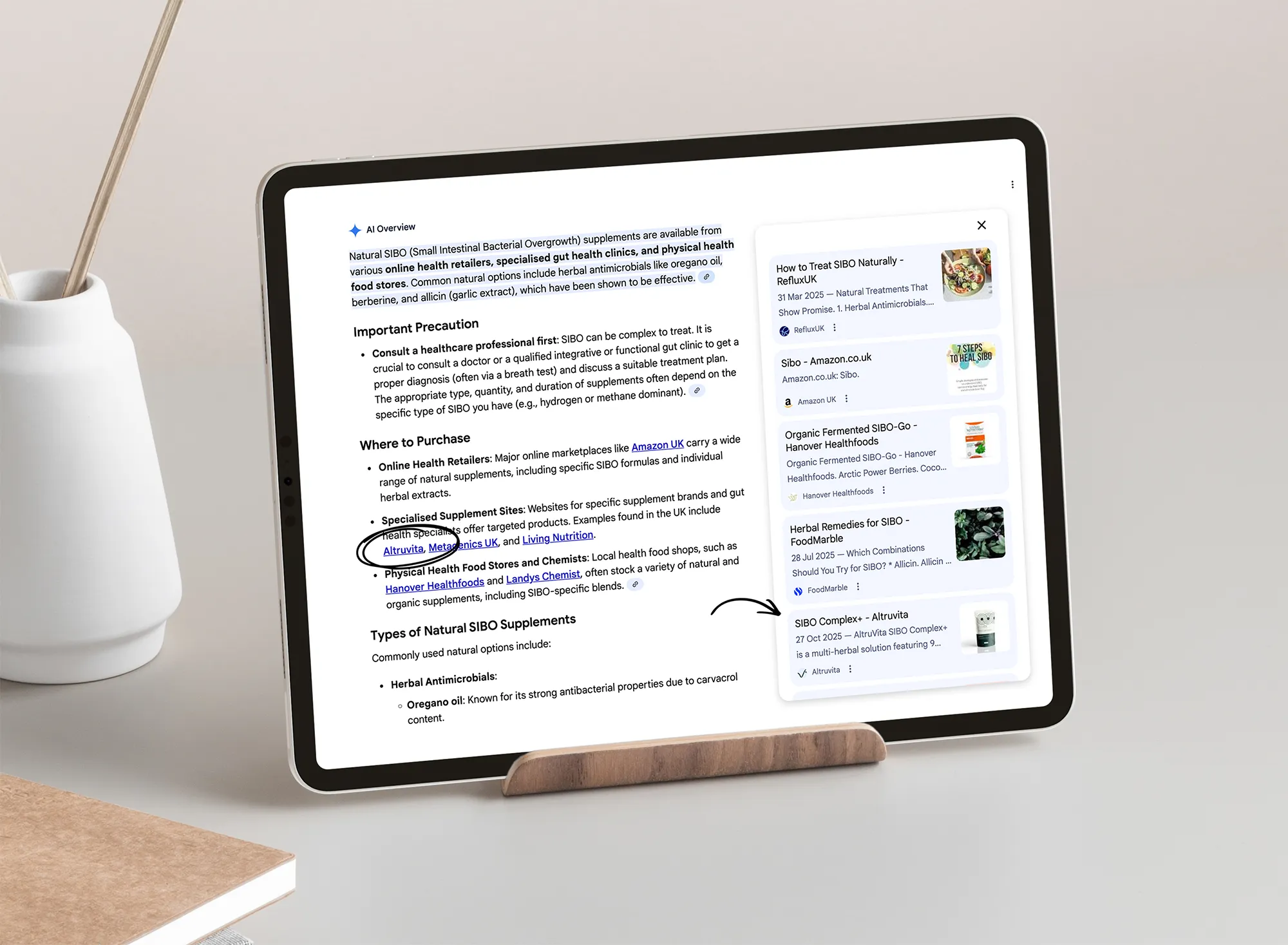
Establish unquestionable E-E-A-T (Experience, Expertise, Authoritativeness, Trustworthiness)
Google's core algorithms, including those powering AI Overviews, heavily rely on E-E-A-T signals. High-quality, trustworthy sources are prioritised – another similarity with traditional SEO.
Author credentials: Feature clear author bios with relevant experience, certifications and authority on the topic. Link to author pages where relevant.
Cite reputable sources: Back up your claims with links to authoritative external sources where relevant.
Original research & data: Whenever possible, include original data, case studies or expert insights. This positions your content as a primary source.
Regular updates: Keep your content fresh and accurate. Outdated information erodes trust and authority.
Understand user intent (beyond keywords)
While keywords are still important, the AI Overview content strategy emphasises truly understanding why someone is searching and what they really want to know.
Analyse SERPs: Look at existing AI Overviews, featured snippets, and ‘People Also Ask’ sections for your target keywords. What types of answers are Google currently presenting?
Go further: Don't just answer the surface question; think about follow-up questions and provide comprehensive but concise answers within your content.
Focus on problem-solving: Content that effectively solves a user's problem or clearly answers a specific need is highly valued – by readers and by AI.
New interface, old foundations. SEO hasn’t *really* changed
Are you seeing the pattern form – approaching GEO follows the same principles as SEO – it’s still a digital popularity content but the judges are robots now, rather than human internet users.
The core principals of relevance and trust remain.
To win you still have to prove your content is the most relevant and most trustworthy, you just have to prove it to a robot. You not just writing for an algorithm, you’re writing for a human (often one that’s in a hurry!)
If the human is happy, the algorithm usually follows suit.
By adopting an E-E-A-T content strategy, you're not just optimising for today, you're future-proofing your content for the evolving landscape of search.
At Stick Marketing, we specialise in crafting cutting-edge content strategies that get you seen where it matters most.
Ready to elevate your SEO content for the AI era? Contact us today.